N I Direct government services

Main navigation

  • Home
  • News
  • Contacts
  • Help
  • Twitter
  • Facebook
  • YouTube
  • RSS

Translation help

Translate this page

Select a language

  • Afrikaans — Afrikaans
  • Albanian — Shqip
  • Amharic — አማርኛ
  • Arabic — العربية
  • Armenian — Հայերեն
  • Assamese — অসমীয়া
  • Aymara — Aymar aru
  • Azerbaijani — Azərbaycan dili
  • Bambara — Bamanankan
  • Basque — Euskara
  • Belarusian — Беларуская
  • Bengali — বাংলা
  • Bhojpuri — भोजपुरी
  • Bosnian — Bosanski
  • Bulgarian — Български
  • Cantonese — 廣州話
  • Catalan — Català
  • Cebuano — Sinugbuanong Binisayâ
  • Chichewa — Chichewa
  • Chinese (Simplified) — 简体中文
  • Chinese (Traditional) — 繁體中文
  • Corsican — Corsu
  • Croatian — Hrvatski
  • Czech — Čeština
  • Danish — Dansk
  • Dhivehi — ދިވެހި
  • Dogri — डोगरी
  • Dutch — Nederlands
  • English — English
  • Esperanto — Esperanto
  • Estonian — Eesti
  • Ewe — Eʋegbe
  • Filipino — Filipino
  • Finnish — Suomi
  • French — Français
  • Frisian — Frysk
  • Galician — Galego
  • Georgian — ქართული
  • German — Deutsch
  • Greek — Ελληνικά
  • Guarani — Avañe’ẽ
  • Gujarati — ગુજરાતી
  • Haitian Creole — Kreyòl ayisyen
  • Hausa — Hausa
  • Hawaiian — ʻŌlelo Hawaiʻi
  • Hebrew — עברית
  • Hindi — हिन्दी
  • Hmong — Hmoob
  • Hungarian — Magyar
  • Icelandic — Íslenska
  • Igbo — Asụsụ Igbo
  • Ilocano — Ilokano
  • Indonesian — Bahasa Indonesia
  • Irish — Gaeilge
  • Italian — Italiano
  • Japanese — 日本語
  • Javanese — Basa Jawa
  • Kannada — ಕನ್ನಡ
  • Kazakh — Қазақ тілі
  • Khmer — ភាសាខ្មែរ
  • Kinyarwanda — Ikinyarwanda
  • Konkani — कोंकणी
  • Korean — 한국어
  • Krio — Krio
  • Kurdish (Kurmanji) — Kurdî
  • Kurdish (Sorani) — کوردی
  • Kyrgyz — Кыргызча
  • Lao — ລາວ
  • Latin — Latina
  • Latvian — Latviešu
  • Lingala — Lingála
  • Lithuanian — Lietuvių
  • Luganda — Luganda
  • Luxembourgish — Lëtzebuergesch
  • Macedonian — Македонски
  • Maithili — मैथिली
  • Malagasy — Malagasy
  • Malay — Bahasa Melayu
  • Malayalam — മലയാളം
  • Maltese — Malti
  • Maori — Māori
  • Marathi — मराठी
  • Meiteilon (Manipuri) — ꯃꯤꯇꯩ ꯂꯣꯟ
  • Mizo — Mizo ṭawng
  • Mongolian — Монгол хэл
  • Myanmar (Burmese) — မြန်မာစာ
  • Nepali — नेपाली
  • Norwegian — Norsk
  • Odia (Oriya) — ଓଡ଼ିଆ
  • Oromo — Afaan Oromoo
  • Pashto — پښتو
  • Persian — فارسی
  • Polish — Polski
  • Portuguese — Português
  • Punjabi — ਪੰਜਾਬੀ
  • Quechua — Runa Simi
  • Romanian — Română
  • Russian — Русский
  • Samoan — Gagana Samoa
  • Sanskrit — संस्कृतम्
  • Scots Gaelic — Gàidhlig
  • Sepedi — Sepedi
  • Serbian — Српски
  • Sesotho — Sesotho
  • Shona — Shona
  • Sindhi — سنڌي
  • Sinhala — සිංහල
  • Slovak — Slovenčina
  • Slovenian — Slovenščina
  • Somali — Soomaali
  • Spanish — Español
  • Sundanese — Basa Sunda
  • Swahili — Kiswahili
  • Swedish — Svenska
  • Tajik — Тоҷикӣ
  • Tamil — தமிழ்
  • Tatar — Татар теле
  • Telugu — తెలుగు
  • Thai — ไทย
  • Tigrinya — ትግርኛ
  • Tsonga — Xitsonga
  • Turkish — Türkçe
  • Turkmen — Türkmençe
  • Twi — Twi
  • Ukrainian — Українська
  • Urdu — اردو
  • Uyghur — ئۇيغۇرچە
  • Uzbek — Oʻzbekcha
  • Vietnamese — Tiếng Việt
  • Welsh — Cymraeg
  • Xhosa — IsiXhosa
  • Yiddish — ייִדיש
  • Yoruba — Yorùbá
  • Zulu — IsiZulu
  • Breadcrumb

    1. Home
    2. Motoring
    3. Learning to drive and new drivers
    4. Learn to drive

    Guidance for parents and supervising drivers

    The supervising driver will play an important role in helping a learner driver to complete their training and gain practical driving experience during the mandatory minimum learning period.

    Role of a supervising driver

    To qualify as a supervising driver, you must be at least 21 years old and hold a full NI driving licence. 

    You must have held your full driving licence for at least three years.

    Key responsibilities include:

    • supervising practice sessions while the learner driver gains experience on the road during the mandatory six-month learning period
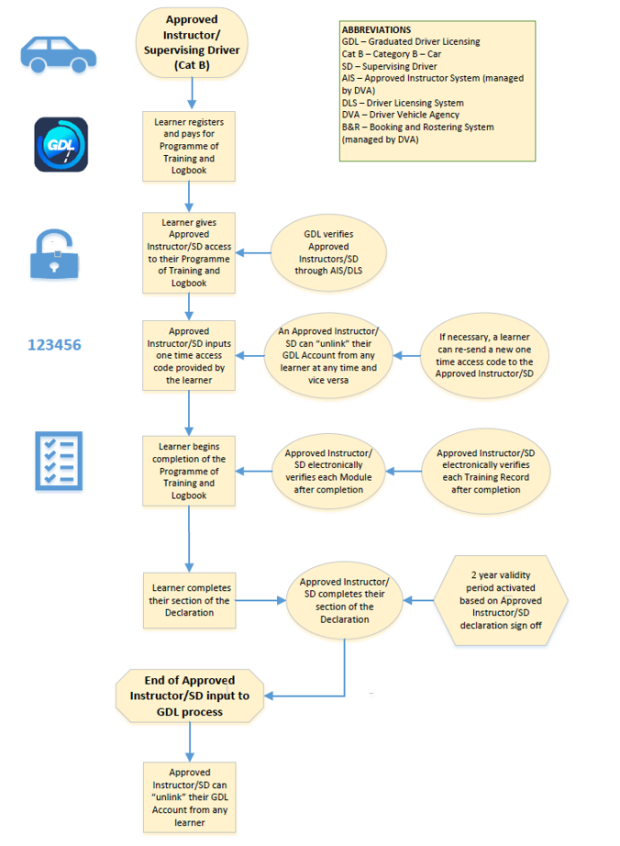
    • supporting completion of the Graduated Drivers Licensing (GDL) Programme of Training and Logbook, which records the learner's progress and required learning activities
    • signing off the Programme of Training and Logbook once the learner has completed the relevant training - the Logbook can be signed off by a supervising driver, or an approved instructor
    • helping reinforce safe driving attitudes and behaviours, which is a central aim of the new GDL scheme

    This means a parent, guardian, or other qualified driver may continue to help someone learn to drive. 

    Learners can use a supervising driver, an approved driving instructor, or a combination of both. 

    More useful links

    • GDL monitoring report
    Share this page Share on Facebook (external link opens in a new window / tab) Share on X (external link opens in a new window / tab) Share by email (external link opens in a new window / tab)

    Learn to drive

    • Choosing a driving instructor
    • Driving eyesight requirements
    • Driving test fees
    • Eco safe driving for cars, lorries and buses
    • Find driving or motorcycle instructors
    • Graduated Driver Licensing for newly qualified drivers
    • Guidance for parents and supervising drivers
    • How attitude, emotion, behaviour and decision-making affect driving
    • Learning to drive with a disability
    • Minimum ages and rules for learner drivers and riders
    • Planning and recording how you learn to drive
    • Safer, more prepared drivers
    • Why Graduated Driver Licensing is being introduced in NI

    Help improve this page - send your feedback

    What do you want to do?
    Report a problem
    Which problem did you find on this page? (Tick all that apply)

    Messages

    This is the official government website for Northern Ireland. You will not receive a reply. nidirect will consider your feedback to help improve the site. 

    Do not include any personal or financial information, for example National Insurance, credit card, or phone numbers. 

    What is your question about?

    What to do next

    Comments or queries about angling can be emailed to anglingcorrespondence@daera-ni.gov.uk 

    If you have a comment or query about benefits, you will need to contact the government department or agency which handles that benefit.  Contacts for common benefits are listed below.

    Carer's Allowance

    Call 0800 587 0912
    Email 
    dcs.incomingpostteamdhc2@nissa.gsi.gov.uk

    Discretionary support / Short-term benefit advance

    Call 0800 587 2750 
    Email 
    customerservice.unit@communities-ni.gov.uk

    Disability Living Allowance

    Call 0800 587 0912 
    Email dcs.incomingpostteamdhc2@nissa.gsi.gov.uk

    Employment and Support Allowance

    Call 0800 587 1377

    Jobseeker’s Allowance

    Contact your local Jobs & Benefits office

    Personal Independence Payment

    Call 0800 587 0932

    If your query is about another benefit, select ‘Other’ from the drop-down menu above.

    Comments or queries about the Blue Badge scheme can be emailed to bluebadges@infrastructure-ni.gov.uk or you can also call 0300 200 7818.

    For queries or advice about careers, contact the Careers Service.

    For queries or advice about Child Maintenance, contact the Child Maintenance Service.

    For queries or advice about claiming compensation due to a road problem, contact DFI Roads claim unit.

    For queries about your identity check, email nida@nidirect.gov.uk and for queries about your certificate, email covidcertni@hscni.net.

    For queries or advice about criminal record checks, email ani@accessni.gov.uk

    Application and payment queries can be emailed to ema_ni@slc.co.uk

    For queries or advice about employment rights, contact the Labour Relations Agency.

    For queries or comments about a GP practice, contact the practice directly. If information about the GP practice is missing, outdated or wrong, email Business Services Organisation (BSO) at: professionalsupportteam@hscni.net.

    For queries or advice about birth, death, marriage and civil partnership certificates and research, contact the General Register Office Northern Ireland (GRONI) by email gro_nisra@finance-ni.gov.uk

    For queries about your GRONI account, email gro_nisra@finance-ni.gov.uk.

    For queries about the High Street Spend Local Scheme,  email HSSS.mail@economy-ni.gov.uk.

    For queries about:

    • Car tax, vehicle registration and SORN
      contact the Driver and Vehicle Licensing Agency (DVLA), Swansea
       
    • Driver licensing and tests, MOT and vehicle testing, contact the DVA online

    If your query is about another topic, select ‘Other’ from the drop-down menu above.

    For queries about your identity check, email nida@nidirect.gov.uk.


    For queries or advice about passports, contact HM Passport Office.

    For queries or advice about Penalty Charge Notices (PCNs), including parking tickets and bus lane PCNs, email dcu@infrastructure-ni.gov.uk

    For queries or advice about pensions, contact the Northern Ireland Pension Centre.

    If you wish to report a problem with a road or street you can do so online in this section.

    If you wish to check on a problem or fault you have already reported, contact DfI Roads.

    For queries or advice about historical, social or cultural records relating to Northern Ireland, use the Public Record Office of Northern Ireland (PRONI) enquiry service.

    For queries or advice about rates, email LPSCustomerTeam@lpsni.gov.uk

    For queries or advice about  60+ and Senior Citizen SmartPasses (which can be used to get concessionary travel on public transport), contact Smartpass - Translink.

    If you have a question about a government service or policy, you should contact the relevant government organisation directly. 

    Related sites

    • gov.uk
    • nibusinessinfo.co.uk

    Links to supporting information

    • Accessibility statement
    • Crown copyright
    • Terms and conditions
    • Privacy
    • Cookies
    • Twitter
    • Facebook
    • YouTube
    • RSS