
Newborn jaundice
Jaundice in newborn babies is a common, usually harmless condition. It causes yellowing of the skin and the whites of the eyes. The symptoms usually develop two to three days after birth. They tend to get better without treatment, resolving by the time the baby is about two weeks old.
Symptoms of newborn jaundice
The medical term for jaundice in babies is neonatal jaundice.
If your baby has jaundice, their skin will look slightly yellow. The yellowing of the skin usually starts on the head and face, before spreading to the chest and stomach.
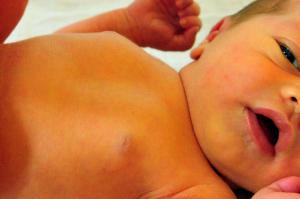
Other symptoms of newborn jaundice can include:
- yellowing of the palms of the hands or soles of the feet
- dark, yellow urine – a newborn baby's urine should be colourless
- pale-coloured poo – it should be yellow or orange
A newborn baby with jaundice may also:
- be poor at sucking or feeding
- be sleepy
- have a high-pitched cry
- be limp and floppy
When to seek medical advice
Your baby will be examined for signs of jaundice within 72 hours of being born, during the newborn physical examination.
All newborn babies should have this examination carried out along with screening tests for inherited conditions.
If your baby develops signs of jaundice after this time, speak to your midwife, health visitor or GP as soon as possible for advice.
If your baby is born outside hospital and develops jaundice in the first 24 hours after being born, they should be admitted to hospital urgently.
Jaundice starting this soon after being born may show there is a cause for the jaundice that requires treatment.
The usual newborn jaundice starts after 24 hours and more usually appears at two days old.
While jaundice isn't usually a cause for concern, it's important to find out whether your baby needs treatment.
This will depend on a clinical assessment and probably a blood test (to check the level of bilirubin - see below).
If your baby is being monitored for jaundice at home, it's also important to contact your midwife urgently if their symptoms suddenly get worse or they become very reluctant to feed.
Reasons your baby may have jaundice
Jaundice is caused by the build-up of bilirubin in the blood. Bilirubin is a yellow substance produced when red blood cells are broken down.
The liver in newborn babies is also not fully developed. This means it's less effective at removing the bilirubin from the blood.
By the time a baby is about two weeks old, their liver is more effective at processing bilirubin. This means jaundice often corrects itself by this age without causing any harm.
There are other causes of jaundice in newborn babies, but these are much less common.
How common is it
Jaundice is one of the most common conditions that can affect newborn babies.
It's estimated 6 out of every 10 babies develop jaundice, including 8 out of 10 babies born prematurely (babies born before week 37 of the pregnancy).
Only about 1 in 20 babies has a blood bilirubin level high enough to need treatment.
For reasons that are unclear, breastfeeding a baby increases the risk of them developing jaundice, which can often persist for a month or longer.
In most cases, the benefits of breastfeeding far outweigh any risks associated with jaundice.
Treating newborn jaundice
Most cases of jaundice in babies don't need treatment. Symptoms of jaundice in babies normally pass within 10 to 14 days.
Treatment is usually only recommended if tests show a baby has very high levels of bilirubin in their blood.
This is because there's a small risk the bilirubin could pass into the brain and cause brain damage, if the levels are very high.
Most babies respond well to treatment and can leave hospital after a few days.
More useful links
The information on this page has been adapted from original content from the NHS website.
For further information see terms and conditions.